
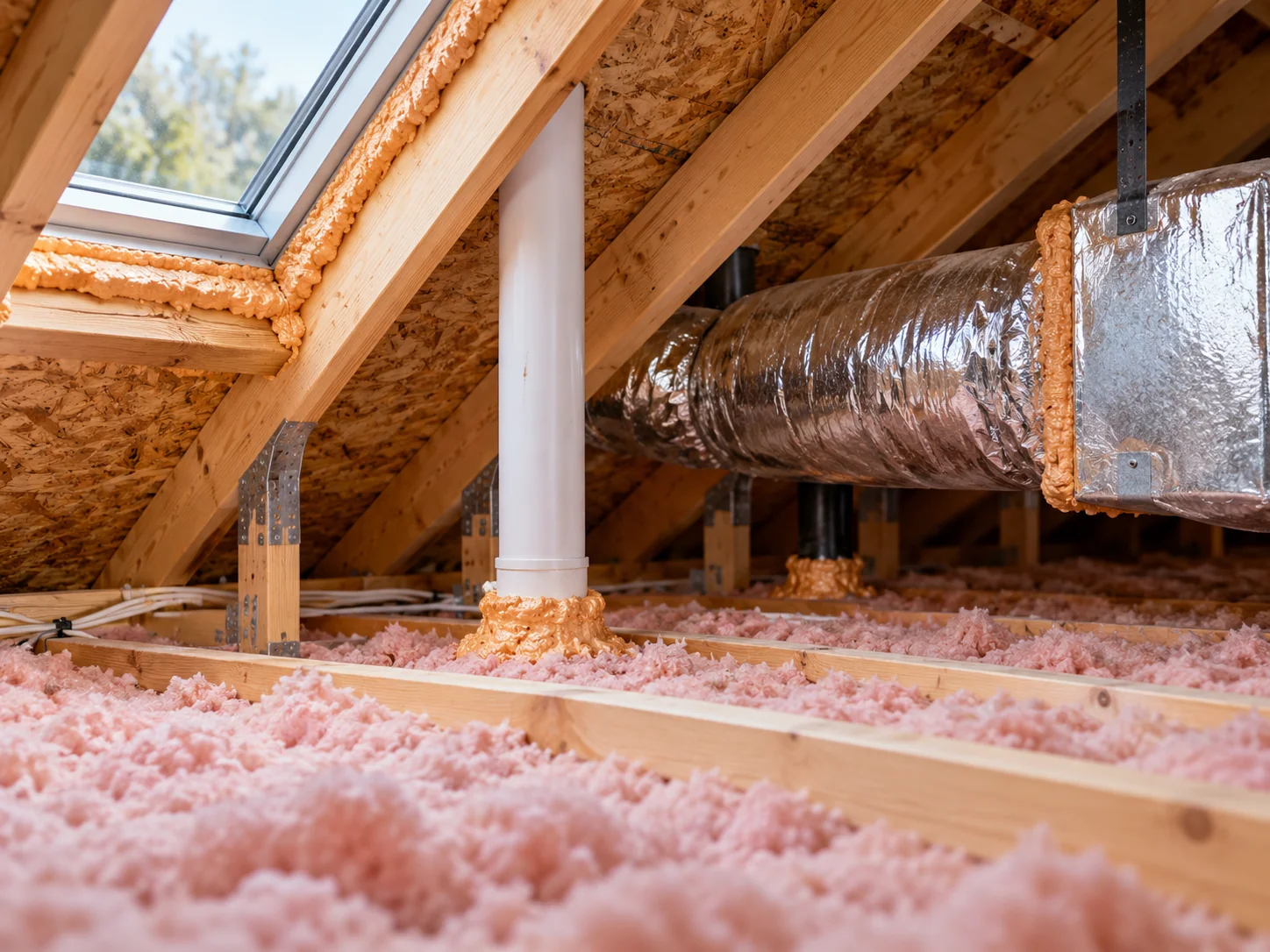
Insulation slows heat flow. Air sealing controls unintended air movement. Good attic work considers both, along with ventilation and moisture.
They solve different problems
Insulation and air sealing are often spoken about as if they are the same upgrade. They are not. Insulation resists heat flow through building materials. Air sealing reduces the uncontrolled movement of air through gaps and penetrations.
A deep layer of insulation can still sit above an attic floor that leaks warm indoor air through dozens of small openings.
Why moving air matters
Air can carry both heat and moisture. During winter, warm indoor air that leaks into a cold attic can deposit moisture on cold surfaces. During summer, uncontrolled air movement can also work against cooling and comfort.
That is why an attic improvement should consider the ceiling plane below the insulation, not just the depth visible from above.
Common leakage points
Attic hatches, plumbing stacks, wiring holes, dropped ceilings, pot lights, partition walls, chimney chases and duct penetrations can all create leakage paths. Some are obvious; many are hidden beneath existing insulation.
A careful retrofit often means moving insulation temporarily, sealing the penetrations that are appropriate to seal, then restoring or upgrading the insulation layer.
Where insulation still matters
Once major leakage paths are controlled, insulation can do its job more effectively by slowing heat transfer through the ceiling. Coverage should be even, and the insulation should not block necessary soffit ventilation.
Different insulation products can work well when they are installed for the assembly and used according to their intended application.
Do not ignore moisture sources
Bathroom exhaust, kitchen exhaust, roof leaks and high indoor humidity can all affect attic moisture. An insulation contractor should not assume every damp attic is simply under-insulated.
The correct sequence is diagnosis first, then a scope that addresses the actual sources.
The LCKD takeaway
R-value is important, but it is not the whole attic story. Air sealing, insulation, ventilation and moisture control should be evaluated together so one improvement does not hide another problem.
This guide is general educational information. Every roof and building assembly is different; site conditions, manufacturer instructions and applicable requirements should be reviewed before work is specified.